In the US, we are starting the “Walking Season” when JDRF asks us to walk to raise money for cure. So I’d like to do my part, by reminding you all how important JDRF is to the human trials of potential cures for type-1 diabetes, which I track.
Let me give you the punch line up front: 63% of the treatments currently in human trials have been funded by JDRF. (And the number is 66% for the later phase trials) This is an strong impact; one that any non-profit should be proud of.
This summary does not include Artificial Pancreas research or stem cell trials, which I discuss separately. The list is a list of treatments, not a list of trials. For example, the “ATG and autotransplant” treatment is actually running three trials, but since they are testing the same treatment, it is only one item in the list. DiaPep277 is running several trials, Rituximab has two, and so on. Finally, those treatments marked “(Established)” have at least one trial which is open to people who have had type-1 diabetes for over a year. So those are open to non-honeymoon diabetics.
Also remember that I give an organization credit for funding a treatment if they funded it any any point in development; I don’t limit it to the current trial. For example, JDRF is not funding the current trials for DiaPep277, but they did fund much of the early research into it, which allowed it to grow into human trials.
Cures in Phase-III Human Trials
Summary: there is only one treatment in phase-III right now, and it has been funded by JDRF.
- Andromedia’s DiaPep227
This treatment has more than one study active right now.
Cures in Phase-II Human Trials
Summary: there are 14, and 9 of them have been funded by JDRF, either directly or indirectly through ITN. Here are the treatments that have been funded by JDRF:
- Abatacept by Orban at Joslin Diabetes Center
- Diabecell by Living Cell Technologies (Established)
- Exsulin (previously INGAP) by Exsulin (Established)
- Kineret / Anakinra by Mandrup-Poulsen at Steno Diabetes Center
- Rituximab by Pescovitz at Indiana
- Sitagliptin and Lansoprazole at Sanford Health
- Thymoglobulin (also known as ATG) by Gitelman
- Umbilical Cord Blood Infusion by Haller at University of Florida
- Xoma 52 by Xoma Corp (Established)
Not funded by JDRF:
- ATG and autotransplant by Burt, and also Snarski, and also Li
- Atorvastatin (Lipitor) by Willi at Children’s Hospital of Philadelphia
- Brod at University of Texas-Health Science Center
- Canakinumab by TrialNet
- NI-0401 by NovImmune
Cures in Phase-I Human Trials
Summary: there are 23, and 14 of the are funded by JDRF and 9 are not. Here is the list funded by JDRF:
- Alefacept by TrialNet
- AAT or Alpha-1 antitrypsin by OmniBio and also Kamada
- ATG and GCSF by Haller at University of Florida (Established)
- BHT 3021 by Bayhill Theraputics (Established)
- CGSF by Haller at University of Florida
- Trucco at Children’s Hospital of Pittsburgh (Established)
- IBC-VS01 by Orban at Joslin Diabetes Center
- Leptin by Garg at University of Texas
- Nasal insulin by Harrison at Melbourne Health
- Polyclonal Tregs by Gitelman at University of California San Francisco
- Pro insulin peptide by Dayan at Cardiff University
- Proleukin and Rapamune by Greenbaum at Benaroya Research Institute (Established)
- Lisofylline by DiaKine
- Stem Cell Educator by Zhao (Established).
Not funded by JDRF:
- BCG by Faustman at MGH (Established)
- CGSF and autotransplant by Esmatjes at Hospital Clinic of Barcelona (Established)
- Encapsulated Islets at University clinical Hospital Saint-Luc (Established)
- Etanercept (ENBREL) by Quattrin at University at Buffalo School of Medicine
- GABA by Lunsford at the University of Alabama at Birmingham.
- Monolayer Cellular Device (Established)
- Rilonacept by White at University of Texas
- The Sydney Project, Encapsulated Stem Cells (Established)
- Pioglitazone by Wilson at Stony Brook
Summary of all Trials
38 in total
24 funded by JDRF
So 63 % of the human trials currently underway are funded (either directly or indirectly) by JDRF. Everyone who donates to JDRF should be proud of this huge impact; and everyone who works for JDRF or volunteers for it, should be doubly proud.
Just Looking at Trials on Established Type-1 Diabetics
13 in total (34% of all trials)
8 funded by JDRF
So 62% of the trials recruiting established type-1 diabetics, are funded by JDRF.
Compared to Last Year
In 2011 there were 37 treatments in clinical trials, in 2012 there are 38 (growth of 3%)
In 2011 there was 1 treatments in Phase-III trials, in 2012 there is still 1 (no change).
In 2011 there were 16 treatments in Phase-II trials, in 2012 there are 13 (drop of 23%).
In 2011 there were 20 treatments in Phase-I trials, in 2012 there are 23 (growth of 13%).
In previous years I have included some drugs that were basically being tested as treatments (adjuncts to insulin that would give people better control or help them use less insulin). This year, I have removed those from the list. I included them before because there was always a chance they would lead to a cure. I’m now of the opinion that was wishful thinking, so I’m no longer including them here.
How I Count Trials for This Comparison
- I give an organization credit for funding a cure if it funded that cure at any point in it’s development cycle.
- I mark the start of a research trial when the researchers start recruiting patients (and if there is any uncertainty, when the first patient is dosed). Some researchers talk about starting a trial when they submit the paper work, which is usually months earlier.
- For trials which use combinations of two or more different treatments, I give funding credit, if the organization in the past funded any component of a combination treatment, or if they are funding the current combined treatment. Also, I list experiments separately if they use at least one different drug.
- The ITN (Immune Tolerance Network) has JDRF as a major funder, so I count ITN as indirect JDRF funding.
- I have made no attempt to find out how much funding different organizations gave to different research. This would be next to impossible for long research programs, anyway.
- Funding of research is not my primary interest, so I don’t spend a lot of time tracking down details in this area. I might be wrong on details.
- I use the term “US Gov” for all the different branches and organizations within the United States of America’s federal govenment (so includes NIDDK, NIAID, NICHD, etc.)
- I don’t work for the US Gov, JDRF, or any of the other organizations discussed here. I’m an adviser to JDCA. I also own stock in several of the companies discussed here.
This is an update and extension to blog postings that I’ve made for the previous four years:
http://cureresearch4type1diabetes.blogspot.com/2011/10/jdrf-funding-research-for-cure-2011.html
http://cureresearch4type1diabetes.blogspot.com/2010/09/jdrf-funding-research-for-cure-2010.html
http://cureresearch4type1diabetes.blogspot.com/2009/09/jdrf-funding-research-for-cure.html
http://cureresearch4type1diabetes.blogspot.com/2008/10/jdrf-funding-of-cure-research-phases-ii.html
Please think of this posting as being my personal “thank you” note to all the JDRF staff, volunteers, and everyone who donates money to research a cure for type-1 diabetes:
Finally, if you see any mistakes or oversights in this posting, please tell me! There is a lot of information packed into this small posting, and I’ve made mistakes in the past.
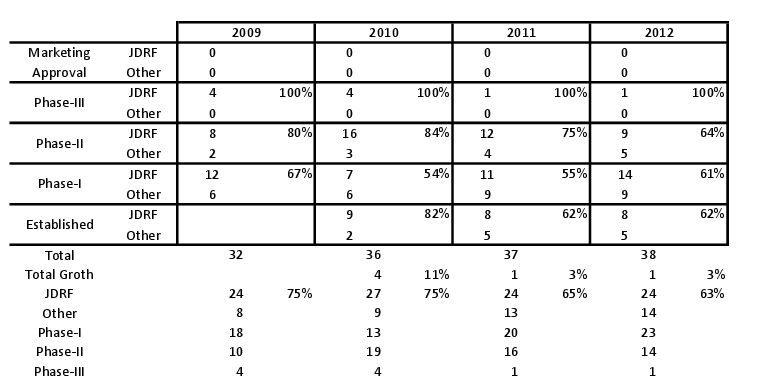
Here is a chart of the number of total clinical trials, and broken down by phases, for each of the last few years:
Joshua Levy
All the views expressed here are those of Joshua Levy, and nothing here is official JDRF or JDCA news, views, policies or opinions. My blog contains a more complete non-conflict of interest statement.
Blog: http://cureresearch4type1diabetes.blogspot.com
Cured in Mice Blog: http://t1dcuredinmice.blogspot.com/